Actor Parity.

The architectural principle that makes humans, AI, and hybrid actors first-class peers inside the same governed workflow.

Patent-protected — US Provisional #64/045,012 (filed Apr 21, 2026)

The principle.

In most AI products, the AI lives in a separate execution lane. There is one API for human actions and another for AI actions. There is one audit pipeline for human-driven changes and another for agent-driven changes. There are two systems pretending to be one.

In Inistate, there is one. The AI gets the same form, the same transition, the same audit shape as a human. The same State → Activity(Form) → State primitive. The same fields populated, the same validation applied, the same history record produced.

We call this Actor Parity. It is the principle on which the harness rests.

Five mechanisms make Actor Parity real.

  1. 01

    Form parity.

    The AI submits the same forms a human would. Validation, required fields, transitions — identical. No "AI fast path."

  2. 02

    Transition parity.

    Every transition is State → Activity(Form) → State, regardless of actor. There is no separate state machine for AI execution.

  3. 03

    Audit parity.

    One history event shape, populated by by, on, changes, and an optional ai object containing reasoning, sources, model, model version, prompt hash, and confidence.

  4. 04

    Confidence and intention parity.

    AI-submitted transitions persist a confidence score. Below the configured threshold, the system records an intention event with flagged: true and the AI must escalate to a human for confirmation. The same primitive supports both autonomous execution and human-supervised pause.

  5. 05

    Promotion parity.

    Activities are typed: human-only, AI-only, hybrid, or any-actor. Promoting an activity from human to AI changes one field. The form, the audit, the validation — unchanged.

Why every other vendor still has two lanes.

Most enterprise software was built around a human user. The data model, the transitions, the audit log, the role-based access — all assume a person at a screen. Adding AI to that architecture is grafting a second execution lane on top, which is why every existing vendor's "AI" ends up with a parallel API, a parallel audit log, and a parallel governance story.

To reach Actor Parity, a vendor must collapse those two lanes back into one. That is an architectural rewrite, not a feature addition. It breaks installed customers and conflicts with the vendor's existing abstractions.

This is why the closest gaps in the market are still 12 to 36 months out, depending on the competitor. The work is not engineering capacity. The work is architectural commitment.

"Form parity. Transition parity. Audit parity. Confidence parity. Promotion parity. Five mechanisms, one principle."

Demo 1 — Multi-Model Relay.

This is the canonical proof for Actor Parity.

01
Demo 1 of 7

Multi-Model Relay

User input

"go to LV 00003 and Approve it"

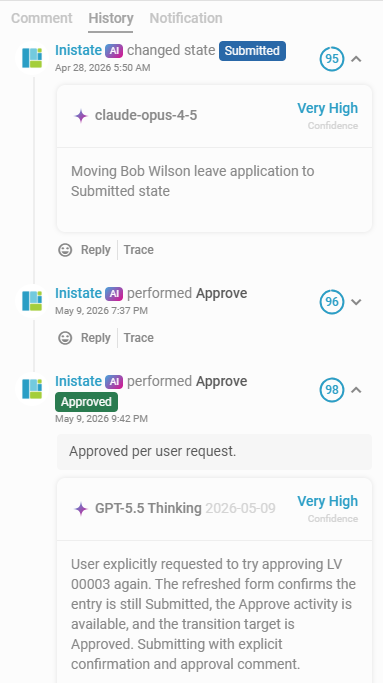
Audit history pane showing Claude and GPT transitions on the same Leave Application entry

The leave application LV 00003 was created by a human (Bob Wilson). Claude Opus 4.5 advanced it to Submitted with confidence 95. GPT-5.5 Thinking approved it with confidence 98. Each transition produced an identical history event shape, with the same fields, the same audit format, and the same governance.

Architectural property

One audit substrate across human, Claude, and GPT-5. Model portability — the workflow ran the same on two model families with no code change. Confidence persistence — both models recorded their confidence on the same field, and either could have been gated below threshold.

What it proves

Different frontier models executing against the same workflow with identical audit shape — no orchestration code, no glue, no special handling.

The architecture holds. Build against it.

The MCP server (v1.0, 19 tools) is the authoritative integration surface. The schema (inistate-schema.json v1.0.0) is the contract. The fastest way to evaluate Actor Parity is to wire your own model to our MCP server and watch the audit trail populate identically across your model and ours.