Three clocks govern enterprise AI.
Two of them churn. One of them compounds.

The model you choose today may change long before the business process it serves. Evaluate the harness for continuity across those changes.

Models are rented. The harness is owned.

The durable investment is in your process definitions and operational history. Software ownership, export rights, and retention depend on your contract.

Three clocks.

The intervals below are illustrative planning horizons, not fixed model lifetimes, regulatory deadlines, or product guarantees.

The model clock

Planning horizon: 4–8 months.

Use a months-long review horizon for model capability, cost, and availability. A replacement may improve a workflow, but it still needs testing against the same contract and acceptance criteria.

The regulation clock

Planning horizon: 18–36 months.

Use a multi-year planning horizon for changes to governance and oversight requirements, with ongoing monitoring between reviews. Actual deadlines depend on jurisdiction and use case. Audit records support evidence gathering; they do not establish compliance by themselves.

The harness clock

Planning horizon: 5–10 years.

Business processes can remain useful for years while their rules evolve. Persistent schemas, versioned changes, and accessible audit history let an organization maintain those processes across model replacements and governance updates.

The procurement implication.

If models change faster than workflows, procurement should evaluate both current model performance and the durability of the operational contract.

Choosing only by the bundled model leaves important questions unanswered: can you replace it, retain your schemas, export your history, and keep the same approval controls?

A persistent schema and shared audit structure reduce the process changes needed for a model migration. They do not eliminate integration work or the need to evaluate the replacement model.

Buy for workflow fit, audit continuity, and model portability.

The economic implication is also significant.

A structured workflow can reduce the amount of process context an agent must infer. That creates an opportunity to evaluate smaller models on well-defined tasks.

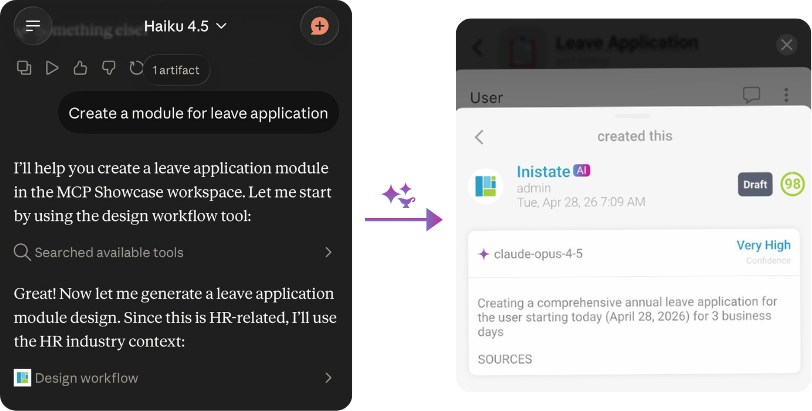
Demo 6 shows Haiku 4.5 invoking workflow design beside a Draft entry whose audit event names Claude Opus 4.5. Demo 7 shows a photo becoming a structured tracking record. Neither capture isolates model cost or measures end-to-end completion time.

Measure cost per successfully completed workflow, including retries, tool calls, and human review. Compare models against the same quality and governance requirements before projecting savings.

06
Demo 6 of 7

Module Creation from One Sentence

User input

"Create a module for leave application"

Haiku 4.5 invoking workflow design beside an Inistate leave entry in Draft with a claude-opus-4-5 audit event
Product screenshot · Select image to view at full size.

The conversation shows Haiku 4.5 receiving a request to create a leave application module and invoking the workflow design tool. The accompanying Inistate capture shows a created leave entry in Draft, with an AI audit event labeled claude-opus-4-5. These captures illustrate module design and entry creation; they do not establish that one model completed the entire lifecycle.

Architectural property

Schema design and entry creation through the harness.

What this shows

A short request can initiate module creation, and the resulting entry has an audit record. This capture does not verify elapsed time, production readiness, or an inference-cost benchmark.

What to put in your RFP.

Use these clauses as a starting point and adapt them to your workflows. Ask vendors to demonstrate each answer with a representative process and its audit history.

  1. 01

    The vendor MUST externalize workflow logic into a persistent, versioned schema that is independent of the model.

  2. 02

    The vendor MUST produce a single audit event shape across human, AI, and hybrid actors, with explicit fields for actor identity, timestamp, changes, and (for AI) reasoning, sources, model, model version, prompt hash, and confidence.

  3. 03

    The vendor MUST demonstrate replacement with a compatible model while preserving workflow logic, schema, and audit format, and document the integration and evaluation required.

  4. 04

    The vendor MUST support confidence-gated execution with intention recording when confidence is below threshold.

  5. 05

    The vendor MUST expose all operational primitives (workflows, schemas, transitions, activities) through a documented protocol (MCP or equivalent) that supports independent integration.

  6. 06

    The vendor MUST document how audit records, retention, access controls, and human review support the applicable oversight requirements, including any controls the buyer must implement.